- iRevolution


The reality is clear: while diseases require increasingly
specialized expertise, the time doctors have available is becoming increasingly scarce. In this context, showing up for an appointment
“with your hands in your pockets” is a luxury that neither the doctor nor the patient can
afford anymore.
The goal is not to turn the patient into a doctor—unsupervised self-diagnosis remains
a pitfall to be avoided—but to give them the tools to become a source of
factual and accurate clinical data. This no longer meets regulatory requirements.

The quality of a diagnosis depends largely on the quality of the medical history (the history of
the illness). However, human memory is selective, and the stress of a doctor’s visit can
cause patients to forget essential details.
 The challenge of timing: a symptom changes over time. A patient may be in the midst of a crisis on Tuesday
and feel perfectly fine on the day of the consultation. Without objective evidence, the
doctor has only a snapshot rather than a “film”
of the condition.
The challenge of timing: a symptom changes over time. A patient may be in the midst of a crisis on Tuesday
and feel perfectly fine on the day of the consultation. Without objective evidence, the
doctor has only a snapshot rather than a “film”
of the condition.
Factual accuracy: Recording the frequency and intensity of symptoms allows the
doctor to save valuable time and refine their clinical assessment.
At iRevolution, we have developed unique expertise in structuring this
exchange even before the appointment, based on three fundamental pillars:
• Usability and the art of questionnaire design: We focus on how to phrase
questions to guide patients through their self-assessment. The goal is to
transform subjective feelings into structured data that can be analyzed by the
healthcare provider.
Long-term monitoring: our solutions make it possible to document the progression of
symptoms over time, thereby providing the physician with a dynamic and
fact-based view of the condition, beyond the single moment of the consultation.
Regulatory compliance and security requirements: because this involves
sensitive health data, our solutions are natively designed to
comply with the GDPR. They are fully aligned with the
Innovation Santé 2030 recommendations, ensuring a high level of security, a
rigorous data structure, and essential interoperability with other
healthcare systems.
Accès facile aux données pour le personnel concerné
Réduction des erreurs de saisie manuelle par des aides à la saisie
Intégration avec les systèmes de production (ERP et MES)
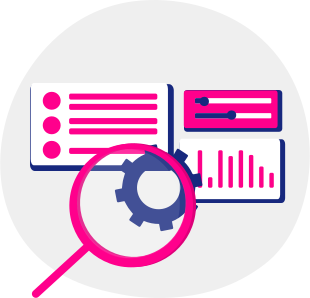
Outils d'analyse intégrés pour évaluer les tendances
Tableaux de bord en temps réel sur les KPI QHSE
Fonctions prédictives pour anticiper les évènements indésirables potentiels.
Numéro unique des événements et CAPA
Trace toutes les modifications (historique)
Outils de recherche et de filtrage pour les auditeurs
Attribution automatique des tâches
Suivi de l'avancement des actions correctives
Alertes et rappels pour assurer le respect des délais
Interface conviviale accessible sur différents appareils
Accès sécurisé aux données pour le personnel concerné

Outils intégrés pour l'analyse des causes (5 Pourquoi, Ishikawa, etc.)
Capacité à lier les actions aux causes profondes identifiées
By arriving with a clear and well-documented medical history, the patient’s role changes: they are no longer merely a passive participant in the consultation; they actively contribute to it. This collaborative approach allows the physician to focus on their core responsibilities: analysis, diagnosis, and treatment strategy. By shifting from passivity to active participation, within a secure technological framework, we are entering a new era of care: more effective, safer, and decidedly more humane.